Is Europe Ready for Climate Impact on Cultural Heritage?
Updated February 2026
On 12 November 2018 the European Commission published the news item “Europe is ready for climate impacts: Commission evaluates its strategy”, presenting the evaluation of the 2013 EU Strategy on adaptation to climate change and lessons learned for future action.
The evaluation confirmed that the strategy had broadly delivered on its objectives, but also that impacts are arriving faster and with greater intensity than originally anticipated, through heatwaves, storms, forest fires and destructive floods affecting all EU regions.
Cultural heritage plays a pivotal economic and social role in Europe. It is a wealth creator that drives tourism, supports creative industries and contributes to local development in many cities and communities.
At the same time, heritage assets are dramatically exposed to climate change and natural hazards, which threaten their integrity and may compromise their value. The loss or deterioration of monuments, historic centres, museums, archives and archaeological areas has profound cultural, identity and socio‑economic consequences.
Yet, when the Commission released its 2018 evaluation of the adaptation strategy, neither the news item nor the accompanying documents explicitly addressed the protection of cultural heritage against climate‑induced impacts. That omission was striking, given that Europe had already funded several pioneering projects on climate risk to cultural heritage, and that 2018 was also the European Year of Cultural Heritage.
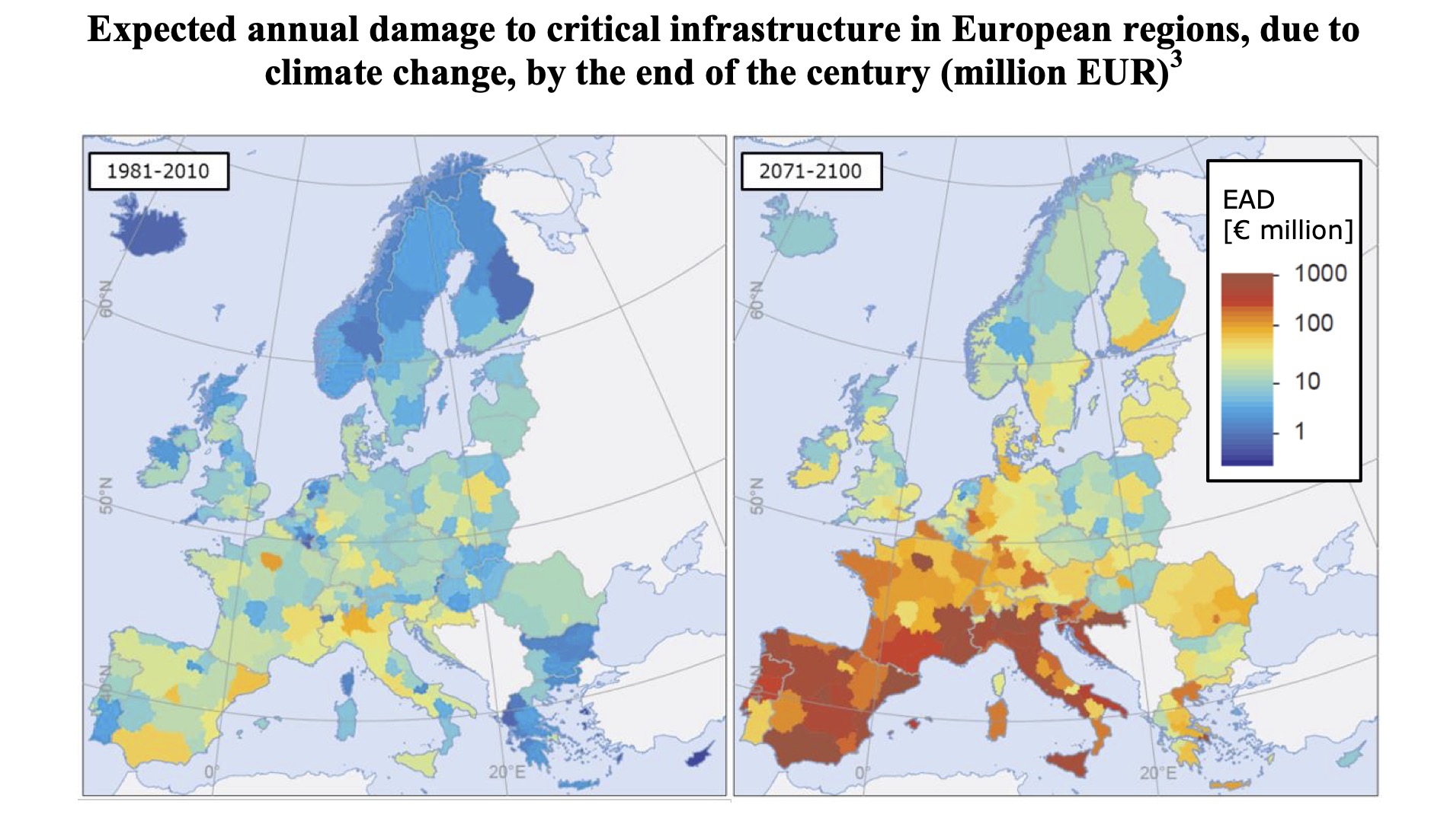
climate change, by the end of the century (million EUR) – Image form the 2018 Report from the Commission to the European Parliament and the Council
on the implementation of the EU Strategy on adaptation to climate change
From “invisible” heritage risks to dedicated EU attention
In the years immediately following the 2013 strategy, heritage was largely treated as a cross‑cutting or “implicit” sector within broader adaptation and disaster‑risk frameworks.
For example, the 2018 evaluation stressed the need to protect citizens and economic sectors, but did not single out cultural heritage as a distinct vulnerability. At the same time, a number of EU‑funded research projects were already demonstrating that climate change can seriously affect monuments, sites and collections:
- CLIMATE FOR CULTURE assessed future indoor and outdoor climate conditions for historic buildings across Europe and their implications for conservation strategies.
- HERACLES (Heritage Resilience Against Climate Events on Site) developed tools and methods to monitor and strengthen the resilience of heritage sites against floods, sea‑level rise and extreme weather.
- STORM (Safeguarding Cultural Heritage through Technical and Organisational Resources Management) focused on integrated risk assessment, early warning and decision support for climate‑ and weather‑related risks to heritage.
Despite this research portfolio, only a limited number of Horizon 2020 calls explicitly addressed climate change impacts on cultural heritage after 2015, with one notable 2017 topic on “Resilience and sustainable reconstruction of historic areas to cope with climate change and hazard events”.
The concern already expressed in 2018 was that cultural heritage might remain marginal within the broader adaptation debate, precisely when climate impacts were accelerating.
Since then, the EU framework has evolved. The 2021 EU Strategy on Adaptation to Climate Change explicitly recognises the need to protect and preserve cultural heritage from climate‑related impacts such as floods, storms and sea‑level rise.
Under the Work Plan for Culture 2019–2022, an Open Method of Coordination (OMC) group of Member States’ experts was established to analyse cultural heritage resilience to climate change and to identify threats, gaps and opportunities where the European Green Deal meets cultural heritage.
Their work confirms that cultural heritage is “under attack” from climate change at unprecedented speed and scale, while comprehensive policies and action plans remain incomplete at both EU and national levels.
In parallel, an April 2024 briefing from the European Parliamentary Research Service (EPRS) on climate change and cultural heritage underlined: the fragmentation between climate and heritage policies, the lack of specific legal frameworks in many Member States, and the need to integrate heritage into all relevant climate instruments, from risk assessments to adaptation funding.
Only a minority of EU countries have formal mechanisms to coordinate climate and cultural heritage policies, even though the EU already supports research, cooperation networks and education programmes in this field.
Climate projections and heritage exposure
Climate projections to mid‑century indicate that Europe will continue to experience warming, more frequent and intense heatwaves, longer and drier fire seasons in many regions, and shifts in precipitation patterns, including more intense rainfall events.
The 2024 European Climate Risk Assessment identifies 36 major climate risks to Europe’s systems and explicitly considers risks for the cultural heritage sector. These include:
- Increased frequency of extreme precipitation, river and coastal flooding affecting historic centres, museums, archives and archaeological sites.
- Sea‑level rise and storm surges threatening coastal heritage landscapes, harbour towns, fortifications and underwater archaeology.
- Temperature and humidity changes leading to more intense material deterioration, salt crystallisation, biological growth and insect infestation in historic buildings and collections.
- More frequent and severe droughts and heatwaves, exacerbating wildfire risk in forested cultural landscapes and at the wildland–urban interface.
Fire risk is particularly relevant for cultural heritage in Europe. A 2023 study combining UNESCO World Heritage data with the European Forest Fire Information System (EFFIS) found that around 40% of managers of Cultural World Heritage Sites in Europe perceive wildfires as an actual or potential threat, while 48% of sites fall into a “high fire risk” category according to the EFFIS fire danger index.
This confirms that wildfires are not only a natural ecosystem issue but also a major hazard for cultural assets.
Climate Change and Heritage Fire Risk
Climate change is altering the conditions under which fire occurs, spreads and impacts heritage sites. Longer fire seasons, higher temperatures, more frequent droughts and wind patterns favouring rapid spread all converge to create more days with high fire danger across southern and, increasingly, central and northern Europe. These trends interact with land‑use changes such as rural abandonment, fuel accumulation and unplanned expansion of the wildland–urban interface, placing historic buildings and archaeological sites at greater risk.
For cultural heritage, climate‑driven fire risk can be grouped into three broad contexts:
- Forested and rural cultural landscapes: monasteries, castles, historic villages, archaeological parks and open‑air museums surrounded by forest, scrubland or grassland are increasingly exposed to large wildfires and long‑range ember attacks.
- Urban and peri‑urban areas: extended heatwaves and droughts can dry urban vegetation, contribute to heat‑related electrical failures and stress old infrastructure, indirectly increasing the probability of accidental fires in dense historic fabrics.
- Museums, archives and collections: higher cooling demand during heatwaves, combined with ageing electrical systems and temporary mitigation measures (portable devices, fans), can raise internal ignition risks at a time when response capacity may be strained by concurrent climate‑related emergencies.
International organisations are increasingly highlighting these links. ICCROM notes that fire, although often perceived as a rare event at the scale of a single institution, becomes a routine, high‑impact hazard when viewed across a nation’s heritage collections, and quantitative risk analyses repeatedly rank fire among the top threats. UNESCO and other bodies warn that climate‑driven heatwaves, droughts and extended fire seasons are intensifying large fires that endanger both natural and cultural heritage.
For risk managers and decision‑makers, this implies that fire risk reduction for heritage cannot be treated as a purely technical or static issue. It must be integrated into climate adaptation planning, informed by evolving fire danger projections, and supported by land‑use, vegetation and community‑based prevention measures around at‑risk sites.
Case studies of climate‑related heritage fires
Several high‑profile fires in the last decade illustrate how climate‑related conditions, combined with vulnerabilities in prevention and preparedness, can lead to catastrophic losses of heritage.
- National Museum of Brazil, Rio de Janeiro (2018): A massive fire destroyed around 90% of the 200‑year‑old museum’s collections, in a context of prolonged underfunding, maintenance deficits and high ambient temperatures. While the exact ignition cause remains debated, ICCROM notes that similar large fires worldwide show how high temperatures, inadequate electrical systems and lack of fire safety upgrades together increase risk for heritage collections.
- Glasgow School of Art, United Kingdom (2014 and 2018): Two major fires in the Mackintosh Building within four years, occurring against a background of changing climate, high restoration complexity and intense construction activity, underlined how even iconic modern heritage is vulnerable when fire protection is not fully commensurate with evolving risks.
- Cultural World Heritage sites in fire‑prone landscapes: Recent analyses of European sites identify many hill towns, monastic complexes and archaeological areas located in regions where climate projections indicate a significant increase in high fire danger days by mid‑century. The study linking UNESCO data and EFFIS indicates that nearly half of European Cultural World Heritage Sites are in areas classified as “high fire risk”, signalling the potential for more frequent heritage‑impacting wildfires in a warming climate.
- Wildfires in Greece and the Mediterranean: Recurrent, climate‑exacerbated wildfires in Greece illustrate how hotter, drier summers and stronger winds interact with land‑use changes to produce more severe fire seasons. These fires have repeatedly threatened archaeological sites, historic settlements and cultural landscapes, even when direct damage has been avoided thanks to emergency protection measures
These events are reminders that climate‑related fire risk is not abstract. It manifests through longer fire seasons, stressed infrastructure, complex restoration works and constrained budgets, creating conditions where a single failure can produce irreversible heritage loss.
Evolving EU initiatives for climate and heritage
Beyond individual projects, the EU is gradually building a more coherent framework linking climate adaptation and cultural heritage protection:
- The EU Strategy on Adaptation to Climate Change explicitly recognises heritage as a sector needing protection and encourages integration of heritage concerns into adaptation plans and funding instruments.
- The Floods Directive, in force since 2007, obliges Member States to report every six years on how many cultural heritage sites may be affected by significant flood risk, embedding heritage into flood risk management planning.
- Climate‑ADAPT, the European adaptation platform, now includes a dedicated cultural heritage section, with key messages, case studies, tools and references on climate impacts and adaptation options for heritage managers.
- Recent EU projects such as YADES aim to map and monitor climate‑related hazards to historic cities and areas, combining atmospheric data, damage functions and simulation tools to support local preventive actions.
- The April 2024 EPRS briefing calls for better integration of heritage into EU climate risk assessments, the development of coherent methodologies for data collection on climate impacts to cultural heritage, and the use of EU funding instruments to support adaptation and mitigation solutions.
In addition, the “European Cultural Heritage Green Paper” and related initiatives argue that cultural and natural heritage are central to achieving the ambitions of the European Green Deal, both by showcasing low‑carbon lifestyles and by offering nature‑based and place‑based solutions for climate resilience.
Fire risk mapping and climate impact maps: attribution and use
Many of the climate‑fire risk analyses for heritage rely on spatial datasets originally developed for environmental or civil‑protection purposes. For Europe, a key resource is the European Forest Fire Information System (EFFIS), operated by the Joint Research Centre, which provides harmonised information on forest fires, including historical burned areas and daily fire danger forecasts.
The 2023 study on fire risk for European Cultural World Heritage Sites explicitly linked UNESCO site locations with the EFFIS fire danger index to estimate how many sites fall in high‑risk zones.
When using EFFIS‑based maps or derivative graphics in heritage risk communication, it is essential to provide complete attribution. A typical attribution for an EFFIS‑derived climate‑fire impact map might read:
If maps integrate additional layers, such as UNESCO World Heritage site locations or national heritage registers, those data sources should also be explicitly cited, following the respective terms of use. This level of transparency not only meets legal and ethical requirements but also helps heritage professionals understand underlying assumptions and limitations when interpreting climate‑fire impact maps.
Looking ahead: priorities for cultural heritage protection
Although significant progress has been made since 2018 in recognising the vulnerability of cultural heritage to climate change, important gaps remain between research, policy and implementation:
- Only a limited number of Member States systematically integrate cultural heritage into climate risk assessments, national adaptation plans and disaster‑risk reduction strategies.
- Coordination between cultural heritage authorities, climate services, civil protection agencies and fire services is still uneven, especially for wildfire‑exposed sites and historic urban areas.
- Funding for adaptation measures in heritage sites is often project‑based and short‑term, while climate‑driven risks such as fire, flood and heat are structural and long‑term.
To address these challenges, several directions are emerging from recent EU documents and international guidance:
- Integrate cultural heritage protection into all relevant climate policies, including adaptation strategies, climate risk assessments, and funding programmes at EU, national and regional levels.
- Develop robust, comparable methodologies and indicators for assessing climate‑induced damages and economic losses to cultural heritage, including from fires, floods and heatwaves.
- Promote innovation in monitoring, modelling and early warning (e.g. remote sensing, IoT sensors, climate‑informed fire danger mapping) tailored to the specific needs of heritage sites.
- Strengthen cooperation between heritage managers, scientists, fire authorities and local communities to create a “fire risk culture” that recognises climate‑amplified hazards and implements preventive measures at landscape and site scale.
Limiting long‑term damage to such an important and vulnerable component of European identity and economic life should be a shared objective of future policies on cultural heritage protection. An ongoing effort to identify and implement innovative solutions for prevention, preparedness, intervention and recovery is necessary, especially as climate change alters traditional risk patterns and introduces new combinations of hazards, including climate‑driven fire risk.