UNESCO and World Bank on Cultural Heritage and Reconstruction: A Critical Analysis of the CURE Framework
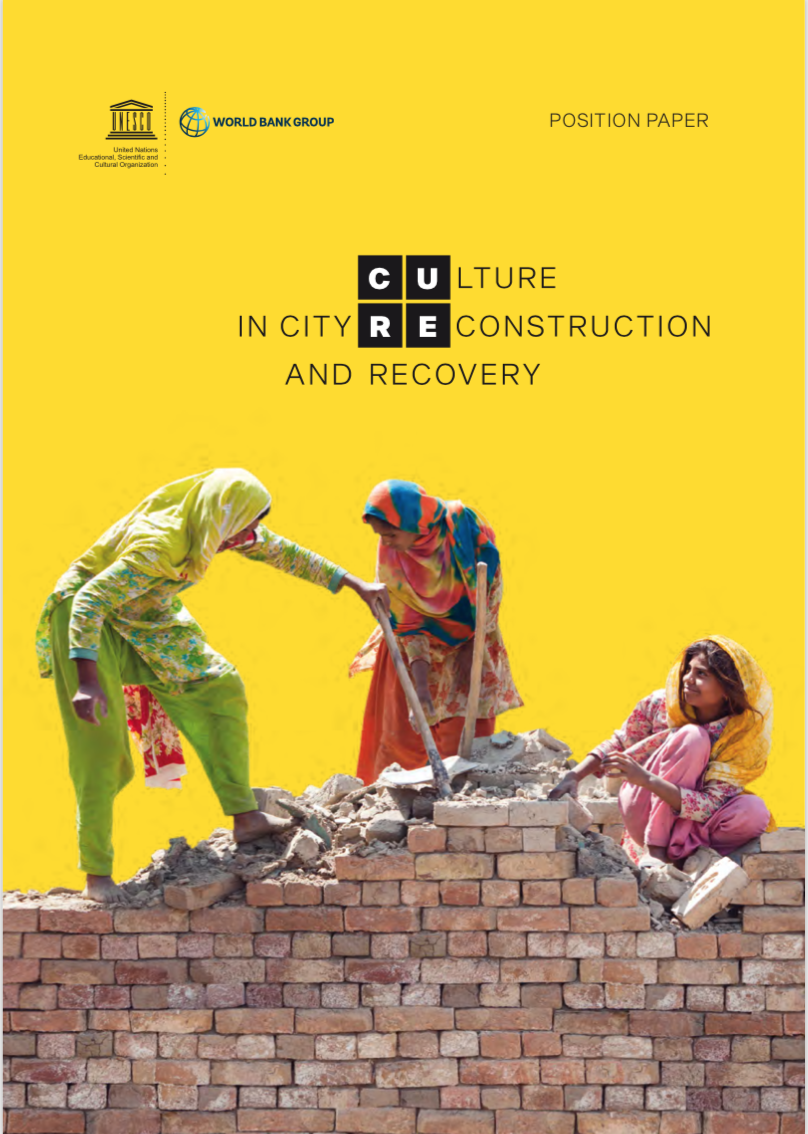
CURE (Culture in City Reconstruction and Recovery) is a position paper published in 2018 by UNESCO and the World Bank Group that proposes, according to the foreword by Enrico Ottone (UNESCO Assistant Director-General for Culture) and Ede Ijjasz-Vasquez (World Bank Senior Director for Urban Development), “a framework on Culture in City Reconstruction and Recovery and operational guidance for policymakers and practitioners for the planning, financing, and implementation phases of post-crisis interventions for city reconstruction and recovery.”
The document represents a significant milestone in recognizing culture as a fundamental component of urban recovery rather than a secondary concern to be addressed after infrastructure and economic needs. However, as with any framework that seeks to operate across vastly different contexts—from conflict zones to natural disaster sites—the CURE Framework merits both recognition for its ambitions and critical examination of its practical limitations.
The document can be downloaded from the UNESCO website or the World Bank website.
The Context: Why CURE Emerged
The framework addresses a genuine gap in post-crisis reconstruction practice.
Historically, disaster recovery and post-conflict reconstruction have prioritized infrastructure, economic recovery, and basic services—treating cultural heritage as either a luxury to address later or, at best, a tourism resource to be exploited for economic benefit.
The authors identify three converging trends that make cultural considerations increasingly urgent:
- Unprecedented urbanization: More than half the world’s population now lives in cities, with this proportion expected to reach 68% by 2050
- Increasing frequency of natural disasters: Climate change and urban expansion into hazard-prone areas have intensified disaster impacts on urban centers
- Targeting of cultural heritage in conflict: Cultural sites have increasingly become deliberate targets in armed conflicts, as seen in Mali, Syria, Iraq, Yemen, and Ukraine
These trends mean that reconstruction efforts, if they fail to account for cultural dimensions, risk not only losing irreplaceable heritage but also undermining social cohesion, economic recovery, and community resilience.
The CURE Framework: Core Components
1 – The Seven Guiding Principles
The framework articulates seven principles intended to guide reconstruction efforts:
Principle 1: Acknowledging the city as a “cultural construct” where built structures and open spaces are closely linked to the social fabric.
Principle 2: Starting the reconciliation process with the (re)construction of cultural landmarks and places of significance to local communities.
Principle 3: Fostering cultural expressions to offer appropriate ways to deal with post-crisis trauma and reconcile affected communities.
Principle 4: Prioritizing culture early in the planning process, starting with needs assessments and the implementation of emergency interventions that reflect community priorities.
Principle 5: Engaging communities and local governments in every step of the recovery process.
Principle 6: Using finance models that balance immediate/short-term needs with the medium/long-term development timeframe of reconstruction plans.
Principle 7: Ensuring effective management of the reconstruction process by striking a balance between people’s needs and the recovery of a city’s historic character.
2 – The Four Operational Phases
The CURE framework proposes four sequential yet overlapping phases:
1. Damage and Needs Assessment and Scoping. This phase encompasses damage assessment of both tangible and intangible cultural heritage, cultural and creative industries, housing, infrastructure, and tourism sectors. It includes economic loss calculations from service interruptions and asset destruction. The scoping process involves data collection, asset mapping, stakeholder mapping, and vision development for reconstruction.
2. Policy and Strategy. This phase translates assessments into policies, strategies, and planning processes through participatory approaches with full stakeholder and community engagement.
3. Financing. This phase identifies modalities for combining public and private financing, managing land resources (described as among cities’ most critical assets), and developing financing tools and incentives.
4. Implementation. The framework emphasizes this as the critical phase for success and sustainability, requiring effective institutional and governance structures, risk management strategies, and communication and engagement strategies.
3 – Strengths of the CURE Framework
Recognition of Culture as Economic Driver. The framework correctly identifies that culture is not merely a cost center in reconstruction but a potential economic engine. Cultural and creative industries can contribute significantly to GDP, employment, and urban attractiveness. By framing culture as both intrinsic value and economic asset, CURE provides advocates with arguments that resonate in policy and financing discussions.
Integration of Tangible and Intangible Heritage. Unlike earlier approaches that focused primarily on physical monuments, CURE explicitly addresses intangible cultural heritage—traditions, languages, social practices, and collective memories. This holistic approach recognizes that reconstruction is not just about rebuilding structures but about restoring the social fabric that gives those structures meaning.
Community-Centered Approach. The emphasis on community participation (Principle 5) represents an important evolution from top-down reconstruction models. Communities living with heritage are positioned not as passive recipients of expert interventions but as active decision-makers whose priorities should shape reconstruction choices.
Institutional Legitimacy. The joint UNESCO-World Bank authorship provides the framework with significant institutional weight. UNESCO brings cultural and heritage expertise; the World Bank contributes financing mechanisms, development economics, and relationships with national governments. This combination gives CURE credibility across sectors that might otherwise dismiss cultural considerations as impractical.
Long-term Planning Horizon. Principle 6’s emphasis on balancing immediate needs with medium- and long-term timeframes acknowledges a frequent failure in post-crisis contexts: the pressure for visible quick wins that undermines sustainable recovery. CURE recognizes that meaningful cultural reconstruction may span decades.
Critical Gaps and Practical Limitations
While the CURE framework represents a conceptual advance, several significant gaps and limitations deserve examination—not to dismiss the framework’s value, but to inform more realistic expectations and identify areas requiring further development.
1 – The Fire Safety Omission
From a fire risk management perspective, the CURE framework exhibits a striking gap: fire safety is essentially absent from the operational guidance. This is particularly concerning because:
- Post-conflict and post-disaster contexts often feature compromised infrastructure, including unreliable water supplies, damaged electrical systems, and disabled fire services
- Reconstruction activities introduce temporary fire risks: construction materials, hot work, exposed combustibles, and disrupted compartmentation
- Historic urban districts undergoing reconstruction are at heightened fire vulnerability precisely when protective systems are absent or incomplete
- The framework discusses “risk management strategy” in the implementation phase but provides no specific guidance on fire risk assessment or fire protection integration
Practical consequence: Cities following CURE guidance may successfully restore cultural landmarks only to lose them again to preventable fires during or shortly after reconstruction—as occurred repeatedly in contexts from Iraq to Haiti.
What’s missing: The framework should explicitly require:
- Fire risk assessment as part of damage and needs evaluation
- Integration of fire protection systems in the early reconstruction phase, not as afterthoughts
- Consideration of fire service capacity and response times in reconstruction planning
- Temporary fire watch and protection measures during construction phases
- Community fire safety training as part of cultural heritage stewardship
2 – Tension Between Authenticity and Safety
The framework advocates for “faithful reconstruction” and preservation of historic character (Principle 7) but provides limited guidance on navigating conflicts between authenticity and modern safety requirements. This tension is particularly acute for fire safety, where:
- Historic construction methods (timber frames, concealed voids, lack of compartmentation) often created inherent fire vulnerabilities
- Modern codes may require fire-resistant materials, sprinkler systems, or egress modifications that alter historic fabric
- Communities and experts often disagree on what constitutes acceptable compromise
Real-world example: The Mackintosh Building in Glasgow underwent faithful reconstruction after a 2014 fire but burned catastrophically again in 2018 before new fire protection systems were commissioned. Should “faithful reconstruction” include replicating dangerous conditions?
What’s missing: The framework needs explicit protocols for:
- Balancing authenticity with life safety obligations
- Defining acceptable interventions that preserve character while reducing risk
- Engaging fire safety engineers early in design processes
- Making transparent trade-offs between competing values
3 – Limited Technical Specificity
While the framework articulates principles effectively, it provides limited concrete operational guidance for practitioners implementing reconstruction projects. The operational guidelines released alongside the position paper offer more detail, but significant technical gaps remain, particularly regarding:
- Methodologies for assessing intangible cultural heritage damage: How do you quantify loss of social practices, collective memory, or community cohesion? Without practical assessment tools, Principle 4’s call to “prioritize culture early” risks becoming aspirational rather than operational.
- Integration with engineering disciplines: The framework discusses “institutional and governance structures” but provides little guidance on how cultural heritage experts should collaborate with structural engineers, fire protection engineers, urban planners, and other technical specialists whose work directly impacts heritage preservation.
- Metrics for success: How do you measure whether reconstruction has successfully “restored social cohesion” or “safeguarded intangible heritage”? The absence of concrete indicators makes it difficult to evaluate whether CURE implementation succeeds or fails.
Practical consequence: Well-intentioned practitioners may struggle to translate CURE’s principles into specific actions, leading to inconsistent implementation and difficulty demonstrating value to skeptical funders.
4 – The Challenge of “Culture First” in Emergency Contexts
Principle 4 calls for “prioritizing culture early in the planning process,” but this confronts a harsh reality: in immediate post-crisis contexts, culture often must compete with urgent demands for medical care, food security, temporary shelter, and basic infrastructure.
The dilemma: While it’s intellectually compelling to argue that cultural reconstruction aids psychological recovery and community resilience, try convincing a population without clean water or functioning hospitals that cultural assessment should be a funding priority.
What the framework underestimates: The political economy of post-crisis reconstruction, where:
- International donors often have rigid funding categories that don’t accommodate integrated cultural approaches
- National governments face immense pressure for visible quick wins
- Media and public attention focus on casualty counts and displaced populations, not intangible heritage loss
- Technical assessment teams may lack cultural heritage expertise entirely
What’s needed: More realistic guidance on:
- How to conduct rapid cultural heritage assessments within emergency response timelines
- Integration of cultural considerations into existing humanitarian assessment tools (e.g., Post-Disaster Needs Assessments)
- Advocacy strategies for securing cultural reconstruction funding in competitive post-crisis environments
- Phased approaches that acknowledge immediate priorities while preserving future cultural reconstruction options
5 – Financing Realities
Principle 6 calls for financing models that balance short- and long-term needs, but the framework provides limited guidance on addressing fundamental financing challenges:
The temporal mismatch: Cultural reconstruction genuinely requires decade-long commitments, but:
- Humanitarian funding operates on 12-month cycles
- Donor attention shifts rapidly to new crises
- Political leadership changes disrupt long-term commitments
- Economic pressures tempt governments to redirect reconstruction funds
The valuation problem: How do you cost-benefit analyze reconstruction of intangible heritage or community spaces that don’t generate direct revenue? The framework discusses culture’s economic value but struggles with heritage that’s valuable precisely because it can’t be monetized.
Insurance gaps: The framework doesn’t address that many cultural heritage assets in vulnerable regions are uninsured or underinsured, leaving reconstruction dependent entirely on donor generosity rather than risk transfer mechanisms.
Practical observation: Successful cultural reconstruction often depends more on sustained advocacy, charismatic champions, and fortuitous political moments than on the systematic financing approaches the framework envisions.
6 – Context Sensitivity vs. Universal Principles
The framework aims to provide guidance applicable across wildly different contexts—from earthquake-damaged historic districts to war-torn cities to areas suffering economic collapse. This breadth is both a strength and weakness.
Conflict vs. natural disaster contexts differ fundamentally:
- Conflict destroys social trust alongside physical infrastructure; natural disasters often strengthen community bonds
- Post-conflict reconstruction involves navigating competing narratives about history, identity, and justice; post-disaster reconstruction typically enjoys more consensus
- Security concerns may prevent access to cultural sites in conflict zones; natural disasters rarely create comparable restrictions
- Funding sources differ dramatically (peacebuilding budgets vs. disaster relief)
What this means: A principle like “starting reconciliation with reconstruction of cultural landmarks” (Principle 2) may be profoundly important in post-conflict Bosnia but irrelevant or even counterproductive in earthquake-affected Nepal, where the priority is simply rebuilding destroyed temples without political overtones.
The risk: Universal principles, if applied without sufficient context adaptation, may produce check-box compliance rather than meaningful cultural integration in reconstruction.
7 – Power Dynamics and Whose Culture Gets Prioritized
The framework’s call for community engagement (Principle 5) is admirable but naive about power dynamics within “communities”:
Who speaks for the community?
- Traditional elites may claim cultural authority that marginalizes women, minorities, or youth
- Diaspora communities may have strong views but limited local legitimacy
- Economic interests (tourism developers, real estate) may hijack “cultural reconstruction” for profit
- Political factions may instrumentalize cultural heritage for competing nationalist or sectarian narratives
Real-world challenges:
- In Iraq’s Mosul reconstruction, different ethnic and religious groups have conflicting visions for rebuilt cultural sites
- Post-earthquake reconstruction in Nepal faced tensions between preserving traditional construction methods and adopting seismic-resistant techniques
- Gentrification often follows “cultural district” reconstruction, displacing original communities
What’s missing: Guidance on:
- Mediating between competing cultural claims and visions
- Ensuring marginalized voices are heard in participatory processes
- Addressing when “community priorities” conflict with international heritage values
- Preventing cultural reconstruction from accelerating displacement or gentrification
Application Challenges: Implementation in Practice
Since CURE’s 2018 publication, several reconstruction efforts have attempted to apply its principles, with mixed results:
Iraq: Mosul Reconstruction
The World Bank and UNESCO collaboration on Mosul’s reconstruction, including the iconic Al-Nouri Mosque and its leaning minaret, represents CURE’s highest-profile application. The project demonstrates both the framework’s potential and its challenges:
Successes:
- Early integration of cultural sites into broader urban recovery planning
- Combination of UNESCO technical expertise with World Bank financing
- International visibility raising funds for cultural reconstruction
Challenges:
- Competing narratives about the mosque’s significance among different communities
- Tensions between rapid reconstruction pressures and careful archaeological documentation
- Security concerns limiting community participation
- Ongoing debates about authenticity: should the minaret’s historic tilt be restored?
Limitations Revealed
Implementation experience reveals that CURE’s principles, while conceptually sound, require significant adaptation to local realities and may underestimate:
- The time required for genuinely inclusive participatory processes
- The technical capacity gaps in post-crisis institutional settings
- The difficulty of coordinating across the multiple agencies involved in urban reconstruction
- The political sensitivities around cultural heritage in divided societies
Recommendations for Fire Safety Professionals
For practitioners in fire risk management working in post-crisis contexts, the CURE framework offers both opportunities and cautions:
1 – Opportunities
- Advocacy leverage: Use CURE’s institutional legitimacy to argue for fire safety integration in cultural reconstruction projects
- Early engagement: The framework’s emphasis on early culture prioritization creates openings for fire protection engineers to participate in initial assessment and planning phases
- Community fire safety: CURE’s participatory approach can incorporate community-based fire prevention and response capacity-building
- Risk-sensitive design: The framework’s long-term perspective aligns with comprehensive fire protection strategies rather than minimal-compliance approaches
2 – Cautions
- Don’t assume fire safety is included: CURE’s silence on fire protection means you must actively advocate for its inclusion
- Navigate authenticity tensions: Be prepared to mediate between strict heritage preservation and fire safety requirements
- Work within limited resources: Post-crisis budgets are constrained; prioritize affordable, maintainable fire protection appropriate to local capacity
- Address both active and passive protection: In contexts with unreliable utilities and compromised fire services, passive fire protection (compartmentation, fire-resistant construction, egress) may be more reliable than active systems (sprinklers, alarms)
3 – Practical Steps
When engaging with CURE-influenced reconstruction projects:
- Conduct fire risk assessment early: Don’t wait for invitation; proactively offer to integrate fire risk evaluation into damage and needs assessments
- Identify cultural heritage-specific fire vulnerabilities: Timber construction, concealed voids, combustible contents, limited egress, compromised water supply
- Propose phased protection strategies: Temporary measures during reconstruction, permanent systems in final design
- Engage local fire services: Build local capacity for heritage fire protection rather than mporting foreign specialists for one-time interventions. This includes:
- Training local firefighters in heritage-specific tactics (e.g., avoiding water damage to artifacts, understanding historic construction vulnerabilities)
- Conducting joint planning exercises between fire services and heritage site managers
Pre-incident planning for significant cultural sites, including access routes, water sources, and artifact salvage priorities - Establishing relationships between fire prevention officers and heritage property owners
Developing local capacity to maintain and inspect fire protection systems
- Document and share lessons: Systematically document fire protection decisions, successes, and failures in reconstruction projects to build the knowledge base for future efforts
- Consider climate adaptation: As the CURE framework notes increasing disaster frequency, integrate climate change projections into fire risk assessment, considering how changing precipitation patterns, temperature extremes, and vegetation stress may alter fire risk profiles
Conclusion: an important but incomplete framework
The CURE Framework represents a significant conceptual advance in recognizing culture as central to urban reconstruction rather than peripheral to it. Its seven principles articulate important values, and its four-phase structure provides a useful organizing logic for complex, multi-year reconstruction efforts.
However, practitioners—particularly those concerned with fire safety—should engage with CURE critically rather than accepting it uncritically:
What CURE does well:
- Elevates cultural considerations to strategic importance
- Provides institutional legitimacy for cultural advocacy
- Integrates tangible and intangible heritage
- Emphasizes community participation
- Acknowledges reconstruction’s long-term nature
- Bridges UNESCO’s heritage expertise with World Bank’s development economics
What CURE underestimates or omits:
- Technical specifics, particularly fire safety integration
- Practical tensions between authenticity and modern safety requirements
- Political and economic constraints that subordinate culture to other priorities
- Power dynamics within “communities” and competition between cultural claims
- Implementation challenges translating principles into specific actions
- The harsh reality that cultural reconstruction often depends on advocacy and champions rather than systematic processes
For fire safety professionals, the CURE Framework is best understood as an advocacy tool and conceptual anchor rather than an operational manual. It provides language and legitimacy for arguing that fire protection should be integrated early in reconstruction planning rather than treated as an afterthought. But it requires substantial augmentation with technical fire safety guidance that the framework itself does not provide.
The framework’s ultimate test will not be in how elegantly it articulates principles but in whether it produces better outcomes for communities recovering from crisis. Early applications in contexts like Mosul suggest both promise and challenges. The question is whether subsequent iterations of the framework will address the gaps identified here—particularly the striking absence of fire safety considerations—or whether these will remain omissions that practitioners must overcome despite rather than because of the framework’s guidance.
For those committed to protecting cultural heritage, CURE is a useful ally—but one that requires critical engagement, local adaptation, and significant supplementation to translate its aspirations into effective practice.
References and Further Reading:
- UNESCO and World Bank Group (2018). “Culture in City Reconstruction and Recovery” (CURE Framework). Available at: UNESCO website
- World Bank and UNESCO (2020). “Overall Operational Guidelines for the Culture in City Reconstruction and Recovery (CURE) Framework”
- World Bank (2020). “Disaster Risk Management in the Culture in City Reconstruction and Recovery (CURE) Framework”
- World Bank (2020). “Peacebuilding and Recovery in the Culture in City Reconstruction and Recovery (CURE) Framework”
- UNESCO (2024). “Revive the Spirit of Mosul” initiative updates
- ICCROM. “First Aid to Cultural Heritage in Times of Crisis” handbook series
Scientific Department | November 25, 2018 | Updated January 28, 2026